Criminal Law and Criminal Justice
Foundations of Crime, Criminal Justice and Punishment: A Comparative Perspective
For students, practitioners, and scholars of criminal justice, this book weaves law, criminology, and institutional analysis—anchored by Iraq's mixed legal system—into a single comparative framework for understanding how societies define, explain, and respond to crime.
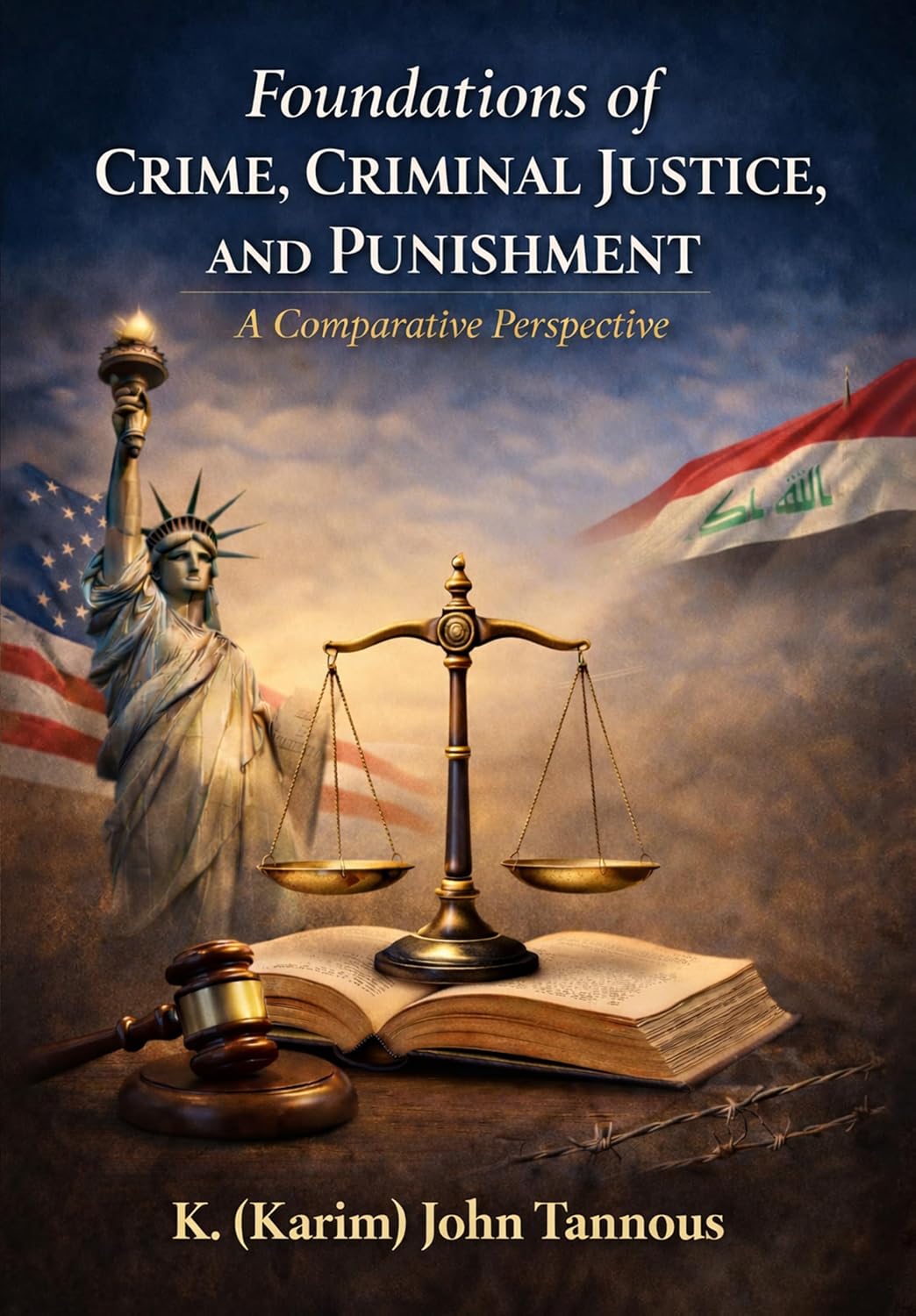
About This Book
This book offers a comparative examination of crime, criminology, criminal justice, and punishment, integrating legal doctrine, social theory, and institutional analysis. Although these subjects are often treated separately, they form an interconnected system in which definitions of crime, explanations of criminal behavior, and institutional responses to wrongdoing mutually shape one another.
The book is written for undergraduate students in Criminal Justice, Criminology, law and related fields, graduate students, and practitioners seeking a structured and conceptually grounded understanding of criminal justice systems. It adopts a comparative approach, drawing primarily on common-law and civil-law traditions while also incorporating Islamic jurisprudence and the contemporary Iraqi legal framework. Iraq is used as a recurring reference point, not as an exceptional case, but as a representative mixed system that illustrates how legal traditions, post- conflict governance, and plural normative orders interact in practice.
The book is organized into four Parts. Part I establishes the legal and normative foundations of crime and justice. Part II examines crime causation and criminological theory. Part III analyzes the institutions of criminal justice and punishment. Part IV concludes the book by summarizing the essence of the book. Together, these Parts provide an integrated framework for understanding crime as a legal construct, a social phenomenon, and an object of state control. Throughout, the book emphasizes clarity, legality, and institutional legitimacy. It avoids treating crime as a purely moral or pathological phenomenon and instead situates criminal law and punishment within broader questions of authority, fairness, and social order. The goal is not to prescribe policy outcomes, but to equip readers with the analytical tools necessary to evaluate criminal justice systems critically and comparatively.
Table of Contents
Organized into four units across 12 chapters
- Crime: Definition, Classification, and Legal Foundations
- Evidence: Proof, Admissibility, and Truth in Criminal Justice
- Comparative Legal Systems and Models of Criminal Justice
- Origins, Sources, and Classification of Law
- Criminology, Criminal Justice, and the Concept of Justice
- Crime, Deviance, and Social Order
- Crime Causation and Theories of Criminal Behavior
- Criminal Responsibility, Culpability, and Legal Accountability
- Law Enforcement As a Component of the Criminal Justice System
- The Judiciary and the Court System in Criminal Justice
- Corrections and the Administration of Punishment
- Conclusion: Crime, Justice, Legitimacy, and the Limits of Punishment
Sample Chapter Preview
Preview Chapter 11 below, or download the full sample as a PDF.
Chapter 11. Corrections and the Administration of Punishment
Download Full Sample (PDF)I. Introduction: Corrections as the Final Stage of Criminal Justice¹
Corrections constitute the final institutional component of the criminal justice system, following law enforcement and adjudication. Whereas policing initiates the criminal process and courts determine guilt and sentence, corrections is concerned with the implementation and administration of punishment. It is at this stage that abstract judicial judgments are translated into concrete and often enduring consequences for offenders, victims, and society at large¹. The term corrections includes the institutions, practices, and policies through which criminal sanctions are carried out. These include imprisonment, probation, parole, community supervision, and post-release monitoring. Historically, this field was referred to as penology, the systematic study of punishment and penal institutions². Although modern terminology emphasizes “correction” rather than punishment alone, the underlying questions remain unchanged: why societies punish, how punishment is administered, and whether punishment achieves its intended purposes³. Corrections uniquely reveal a legal system’s normative commitments. Decisions regarding sentence severity, prison conditions, release mechanisms, and reintegration expose underlying views about moral responsibility, social order, and human dignity more clearly than statutory language alone⁴. This chapter examines corrections through historical, theoretical, and comparative perspectives, situating punishment within broader debates about justice and social control.II. Historical Development of Penal Systems⁵
The origins of punishment predate the modern state. In early societies, responses to wrongdoing were often private, retaliatory, or communal, administered by families, clans, or tribal authorities. As political organization developed, the authority to punish gradually shifted from individuals to centralized institutions acting in the name of society⁶. Early penal practices were frequently public and physical, including corporal punishment, mutilation, and execution. These sanctions served expressive and deterrent functions but were often arbitrary and severe. Over time, Enlightenment thinkers criticized such practices as excessive, irrational, and ineffective⁷. The emergence of the prison as the dominant form of punishment in the eighteenth and nineteenth centuries reflected a broader transformation in social governance, emphasizing discipline, surveillance, and institutional control⁸. Modern correctional systems continue to reflect this historical tension. While overt brutality has largely been replaced by regulated confinement, imprisonment remains a coercive practice that raises enduring questions about proportionality, legitimacy, and humanity⁹.III. Sentencing as the Gateway to Corrections¹⁰
A. Judicial Sentencing Authority Sentencing marks the formal transition from adjudication to correctional control. Following conviction, a court imposes a sentence specifying the type, duration, and conditions of punishment. This decision determines how the correctional system will exercise authority over the offender¹¹. In most legal systems, sentencing authority is vested in judges. Civil-law jurisdictions often integrate sentencing into the trial judgment, while common-law jurisdictions frequently conduct separate sentencing hearings. Although juries historically played a role in sentencing in some systems, modern practice overwhelmingly assigns this responsibility to judicial officers¹². Sentences may include imprisonment, probation, fines, restitution, or combinations thereof. Over the past several decades, intermediate sanctions—such as electronic monitoring, community service, and halfway houses—have emerged as alternatives to incarceration, reflecting concerns about prison overcrowding, cost, and social disruption¹³.IV. The Goals of Punishment¹⁴
Punishment theory traditionally identifies four principal justifications: retribution, deterrence, incapacitation, and rehabilitation. A fifth goal—restitution—has gained increasing prominence. Modern correctional systems rarely adhere to a single theory, instead combining these rationales in practice¹⁵.V. Retribution and Moral Accountability¹⁶
Retribution holds that punishment is justified because the offender deserves it. When an individual violates the law, he or she incurs moral blameworthiness that warrants proportionate punishment. Retributive theory emphasizes accountability rather than social utility¹⁷. A central principle of retribution is proportionality, the idea that punishment should correspond in severity to the seriousness of the offense. This principle appears in ancient legal systems, including the Code of Hammurabi and biblical law, and continues to shape modern sentencing doctrine¹⁸. Retribution does not require that punishment deter crime or rehabilitate offenders. Its justification lies in moral desert and the affirmation of legal norms. Critics argue, however, that retribution risks legitimizing excessive punishment if not constrained by human-rights considerations¹⁹.VI. Deterrence and Rational Choice²⁰
Deterrence theory views punishment as a mechanism for discouraging crime by increasing its expected costs. Specific deterrence targets the punished offender, while general deterrence aims to influence others through example²¹. Classical deterrence theory is closely associated with Cesare Beccaria and Jeremy Bentham, who argued that punishment should be certain, swift, and proportionate rather than severe²². A related concept, marginal deterrence, holds that more serious crimes should be punished more severely than lesser ones to discourage escalation²³. Empirical research suggests that deterrence effects are often limited, particularly where detection rates are low. Certainty of punishment appears more influential than severity, challenging policies that rely on harsh sentences alone²⁴.VII. Incapacitation and Risk Control²⁵
Incapacitation seeks to prevent crime by physically restricting an offender’s ability to offend, typically through imprisonment. Unlike deterrence, incapacitation does not depend on behavioral change or rational calculation²⁶. Incapacitation has played a central role in policies targeting repeat offenders. While such policies may reduce crime in the short term, critics argue that they risk excessive punishment, disproportionate sentencing, and unsustainable correctional costs²⁷.VIII. Rehabilitation and Correctional Treatment²⁸
Rehabilitation is grounded in the belief that criminal behavior is not immutable and can be altered through education, therapy, and social support. Rehabilitative programs include substance- abuse treatment, vocational training, and cognitive-behavioral interventions²⁹. Although rehabilitation dominated correctional philosophy in the mid-twentieth century, skepticism emerged in the 1970s regarding program effectiveness. More recent research, however, supports evidence-based rehabilitation, emphasizing targeted interventions and risk assessment³⁰.IX. Restitution and Restorative Justice³¹
Restitution requires offenders to compensate victims or society for harm caused by crime. Unlike fines, restitution is directed toward repair rather than punishment alone³² Restorative justice expands this concept by emphasizing victim participation, offender accountability, and community involvement. While not appropriate for all offenses, restorative models represent a significant alternative to purely punitive approaches³³.X. Community-Based Corrections³⁴
Modern corrections extend far beyond prison walls. Probation and parole allow offenders to remain in or return to the community under supervision, blending punishment with reintegration³⁵. Comparative research indicates that systems emphasizing community-based sanctions achieve lower incarceration rates without corresponding increases in crime, challenging assumptions about the necessity of imprisonment³⁶.XI. Prison Administration and Conditions of Confinement³⁷
Prisons are governed by administrative regimes regulating security, discipline, and daily life. Administrators must balance order, safety, and human dignity³⁸. International standards, including the UN Standard Minimum Rules for the Treatment of Prisoners (Nelson Mandela Rules), establish minimum requirements concerning overcrowding, medical care, and discipline. Courts increasingly recognize that inhumane conditions may themselves constitute unlawful punishment³⁹.XII. Corrections in Iraq: Legal Framework and Practice⁴⁰
Iraq’s correctional system operates under the Iraqi Penal Code of 1969 and the Code of Criminal Procedure of 1971, supplemented by constitutional protections and international human-rights obligations⁴¹. Iraqi prisons face challenges common to post-conflict systems, including overcrowding, resource limitations, and security concerns. International monitoring has emphasized the need for institutional reform, training, and oversight⁴².XIII. Reintegration, Legitimacy, and Social Order⁴³
Successful corrections require attention to reentry and reintegration. Without access to housing, employment, and social support, released prisoners face elevated risks of recidivism³⁴. Research on legitimacy suggests that punishment perceived as fair and proportionate promotes compliance with law, while arbitrary or degrading treatment undermines social trust⁴⁵.XIV. Comparative Perspectives on Punishment⁴⁶
Comparative analysis reveals significant variation in correctional philosophy. Some systems emphasize severity, others rehabilitation or restoration. These differences reflect broader political, cultural, and historical contexts⁴⁷. Understanding corrections comparatively reinforces a central theme of this work: criminal justice systems express societal choices about responsibility, dignity, and control.XV. Conclusion⁴⁸
The Correctional organization is where the moral and institutional commitments of criminal justice systems are most clearly realized. Through sentencing, confinement, supervision, and reintegration, societies give practical meaning to abstract principles of justice. Together with law enforcement and the Judiciary, corrections complete the structural analysis of criminal justice developed in this book. Comparative Synthesis – sentencing and corrections Comparative analysis of sentencing and correctional institutions demonstrates that punishment is not a single act but a continuum of discretionary and normative decision-making. Sentencing represents the formal articulation of criminal justice theory, while correctional administration embodies its practical implementation. Across legal traditions, differences in structure reflect varying calibrations between uniformity, discretion, and moral accountability. In common-law systems, sentencing has traditionally allowed broad judicial discretion, moderated by appellate review and, in modern contexts, structured guidelines. Correctional policy often oscillates between rehabilitative and punitive models, reflecting shifting social and political priorities. Civil-law jurisdictions more frequently embed proportionality within codified sentencing frameworks, constraining judicial variation and emphasizing consistency. Correctional administration in these systems tends to operate within structured statutory mandates that promote reintegration and administrative oversight. Systems influenced by Islamic legal principles introduce additional moral dimensions to punishment. Fixed penalties for certain offenses coexist with discretionary sanctions and restorative considerations. Correctional approaches may incorporate communal reconciliation and moral reform alongside custodial measures. The comparative insight emerging from these models is that legitimacy in punishment depends on coherence between sentence and execution. Disparities between judicial intention and correctional practice can undermine public confidence. Conversely, alignment between proportional sentencing, humane treatment, and opportunities for reintegration reinforces the moral authority of criminal justice institutions. Sentencing and corrections, therefore, function as interconnected stages in the exercise of coercive power. Whether structured through codification, guided discretion, or moral constraint, systems must reconcile retribution, deterrence, rehabilitation, and dignity. Comparative analysis reveals that institutional legitimacy rests not merely on the severity of punishment, but on the fairness, transparency, and humanity with which it is administered.Instructor Resources
Available Soon
[Instructor resources — such as slide decks, test banks, and solution manuals — will be available to verified instructors here. This section is a placeholder until access and hosting are finalized.]
Request AccessGet the Book
Available in eBook and print. Choose the option that works best for your course.